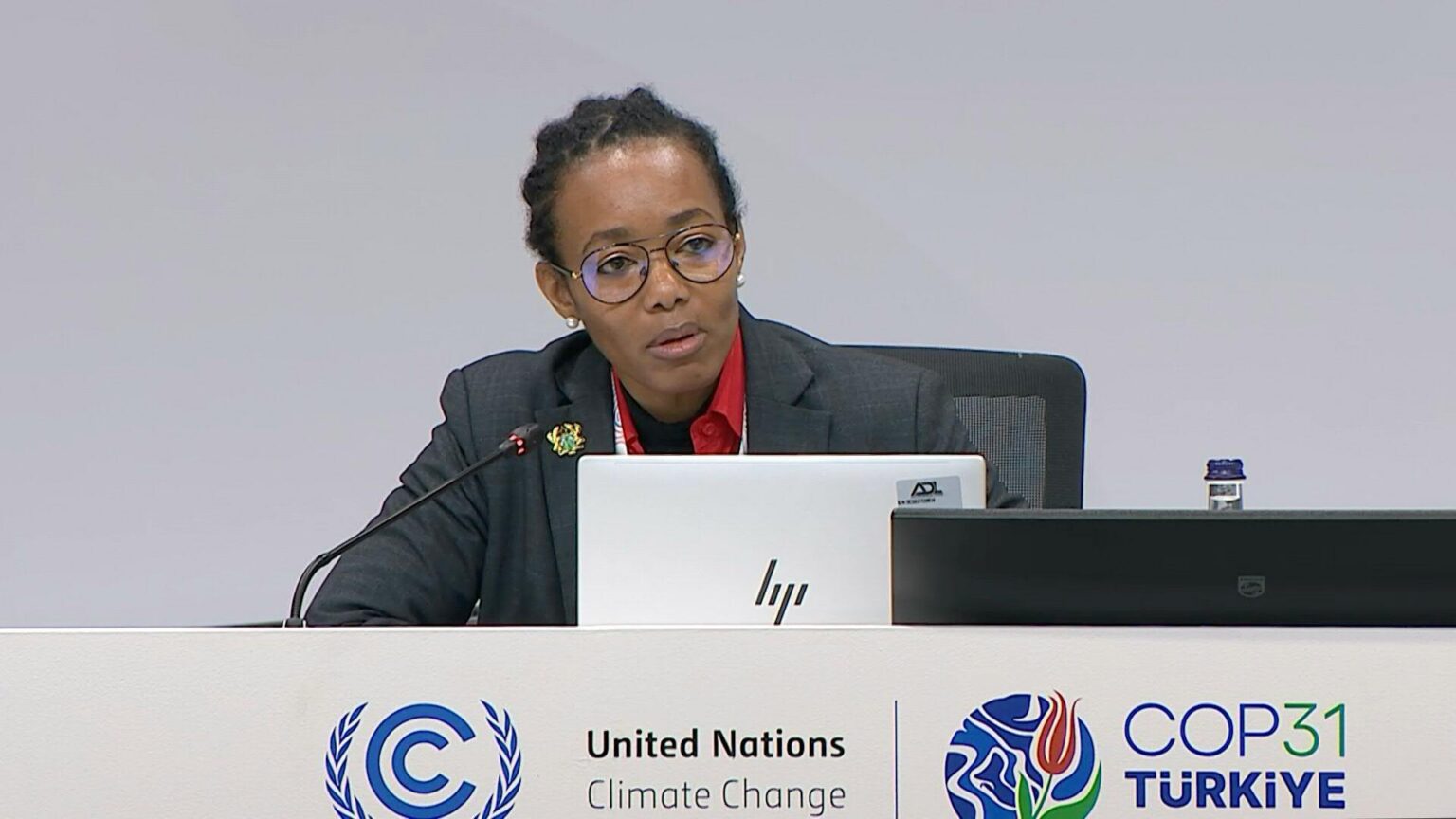
On the final night of COP31 in Antalya, Ghana's Environment Minister, Dr Zanetor Agyeman-Rawlings, rose to read the African Group's closing statement. She was speaking for 54 nations. COP31 President Türkiye's Minister of Environment Murat Kurum cut her off mid-delivery.
The group's chair, Dr Antwi-Boasiako Amoah, objected at once. "You've not shown respect to a group of 54 countries," he told the President. When the minister got the floor back, she was blunt. She had been "rudely cut off," she said, while another party had spoken without interruption.
Kurum later apologised. It was a small moment. But it showed something larger. At climate talks, the Global South is rarely shouted down. It is quietly managed.
Bravo, Ghana! Sometimes a calm rebuttal hits the hardest. COP31 Turkish President interrupted Ghana’s minister. Ghana cited COP’s OWN Code of Conduct, reclaimed the floor & made him publicly APOLOGISE!🔥 https://t.co/HafRbst2Ho
— The Analyzer (News Updates🗞️) (@Indian_Analyzer) · November 25, 2026 · View post on X
Shut out before the talks began
The real sidelining happened on day one, long before the closing plenary.
The African Group came to Antalya with three agenda proposals. One sought a dedicated item on tripling adaptation finance. Another asked for a formal track on climate and trade. Both were dropped when the agenda was adopted on 9 November. Only funding for the Green Climate Fund found a place and even that was folded under an existing item.
Whoever controls the agenda controls the outcome. Africa's core demands were reduced to side conversations before a single draft was written.
Promises without numbers
The gap is stark. Developing countries will need about $305 billion a year for adaptation by 2035. In 2024, international public adaptation finance stood at just $28 to 32 billion.
The draft cover decision repeated the goal to at least triple adaptation finance by 2035. But it named no baseline and no figure. Both were pushed to the next session.
A goal with no starting point cannot be measured. A goal that cannot be measured cannot be enforced. As the African Group put it in Antalya, "a commitment without a baseline cannot be called finance."
Even the new Climate Finance Work Programme, a long-standing developing-country demand, went through over objections from the European Union.
The biggest debtor did not turn up. For the second COP in a row, the United States sent no official federal delegation.
This is the country that has put more carbon into the atmosphere than any other. Its absence is not neutral. When the largest historical emitter skips the meeting, the bill stays on the table and nobody signs for it.
A coalition of American governors and mayors did come to Antalya. They brought goodwill. They could not bring Washington's money or its vote.
Who gets into the room
Influence at a COP depends on numbers. Negotiations run in parallel rooms, often through the night. A small team cannot cover them all.
The imbalance in Antalya was plain. More than 92,000 people registered for COP31. The UK alone sent 255 delegates. Eritrea sent three.
Cost and visas keep many poorer delegations thin. Researchers have flagged visa barriers for least developed countries since 2008. Even UN climate chief Simon Stiell conceded at the opening that "many developing countries have not been able to engage fully" with the summit's action track.
Africa gave way. The deal fell anyway.
Africa called the text weak. It listed every gap. Then it agreed not to block it, "in the interest of and protection of multilateralism." It put the process ahead of its own demands.
It made no difference. The "Antalya Pact" collapsed after the EU, the UK, Norway, Panama, Vanuatu and the Marshall Islands rejected it for leaving out fossil fuels. Russia and Saudi Arabia had opposed that language. For the first time since Copenhagen in 2009, a climate summit ended without its main agreement.
The fossil fuel fight is real and vulnerable island states stood with Europe on it. But the result is hard to miss. One bloc's red line sank the text. Africa's unanswered questions on finance went down with it.
Next stop: COP32 Addis Ababa
The unfinished business now moves to African soil. COP32 will meet in Addis Ababa next year, under an African presidency.
The baseline, the figure and the pathway are all still open. So is the bigger question. Can the Global South turn words like "welcomes" and "acknowledges" into money that actually arrives?
Africa's statement in Antalya ended with a promise. It would carry its demands to every negotiating room until they are met.