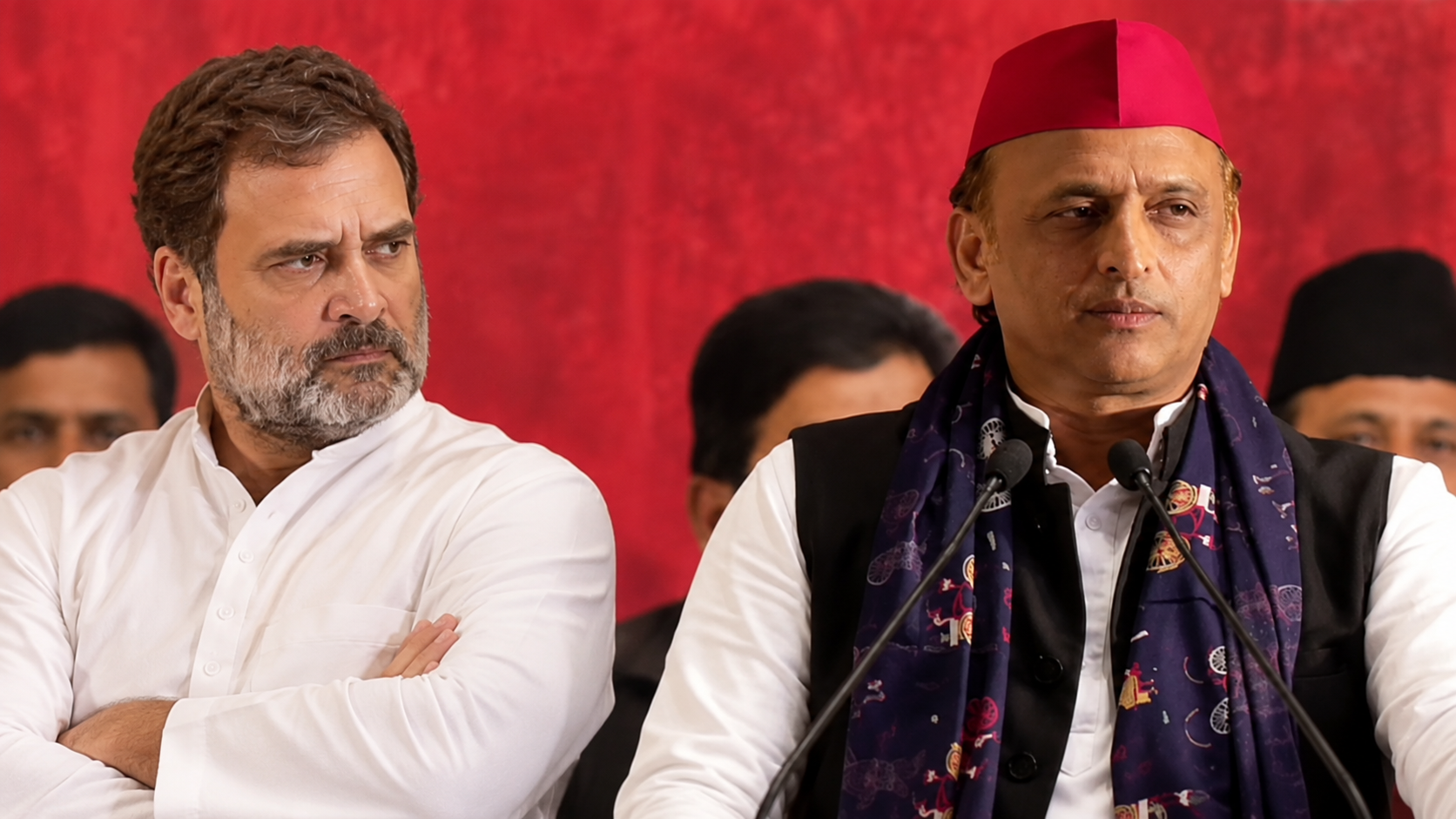
Uttar Pradesh has seen this partnership before and it ended badly. In 2017, the SP and the Congress fought the Assembly elections together under the "UP ke ladke" banner. Voters rejected the pairing decisively.
The BJP and its allies crossed 300 seats in the 403-member House. The SP-Congress alliance managed only 54. The Congress fared worst of all, winning just seven of the 105 seats it contested.
The reactions after the 2017 elections were telling of the end of the alliance. Akhilesh Yadav, then the outgoing Chief Minister, turned to sarcasm. "Perhaps the people of UP didn't like the expressways," he said but "Our alliance with Congress will continue."
Within his own family, the verdict was harsher. SP founder Mulayam Singh Yadav blamed the tie-up squarely. "Alliance with Congress is responsible for the present poor state of the party," he said. He added that he had advised Akhilesh against it.
The Congress camp turned inward too, former AICC spokesperson Rashid Alvi went further, saying the tie-up "became an alliance of Muslim community" and that the BJP took advantage of it.
By early 2018, Akhilesh was reported to have lost interest in a fresh alliance altogether. Nearly a decade later, the two parties are trying again. The early signs suggest the old mistrust never really went away.
In 2026, Akhilesh Yadav did not wait for the negotiating table to be cleared. On Tuesday night, the Samajwadi Party (SP) released five candidates for the Uttar Pradesh Assembly elections. It did so while seat-sharing talks with its ally, the Congress were still underway.
The timing has raised a simple question in political circles. If one partner declares seats before both sides agree, what exactly is left to negotiate?
Five Names, One Clear Message
Four of the five candidates are sitting MLAs. Umar Ali Khan will contest from Behat and Ashu Malik from Saharanpur Dehat. Nahid Hasan returns to Kairana. Mehboob Ali gets Amroha.
The fifth name is a fresh face. The party has fielded Jyoti Lodhi from Lalitpur. In the last election, SP candidate Ramesh Prasad finished third there with 68,597 votes. The BJP won the seat, while the BSP came second. These five join two names Akhilesh had already announced from public platforms.
Reports describe the announcement as a pressure tactic aimed at the Congress. The SP wants to show that its preparations are complete. In the same breath, it claims to remain ready to honour gathbandhan dharma, the duty of coalition partners.
There is a practical message as well. According to reports, the SP believes the time has come to step into constituencies and start groundwork. Winning candidates, the party reasons, should be out in the field early, not waiting on an alliance formula.
Saharanpur: Where the Real Story Lies
Two of the five candidates come from Saharanpur district. That is the home turf of Congress MP Imran Masood. He also sits on the committee that is finalising seats within the alliance.
Masood had made his intentions clear well in advance. He had said Congress would field candidates on both these seats. He had also declared that, whatever shape the alliance took, there would be no compromise on Saharanpur's five Assembly seats. Only his people would contest them, he had said.
VIDEO | Lucknow: As Samajwadi Party releases list of five candidates for UP Polls, Congress MP Imran Masood (@Imranmasood_Inc) says, “Whatever is happening here, it seems that there is a lack of seriousness in this matter. There is a lack of seriousness because while you (Samajwadi Party) are holding talks on one side, you are making declarations on the other, which indicates that this is not being taken seriously. Discussions were being held in a serious manner, and people were sitting together and talking seriously, but suddenly this has happened. So, now we will discuss within our party what we should do, whether we should sit for talks or not, because the decision on what to do in this situation will be taken by the party. When you have made this declaration against me, I don't understand whether you want to fight me, the Congress, or the BJP? It has to be decided, doesn't it, whether you want to fight the BJP or fight us? So, what can I say about this?” (Full video available on PTI Videos - https://t.co/bIyFWTfmBd)
— Press Trust of India (@PTI_News) · November 25, 2026 · View post on X
According to media reports, Masood was lobbying for a close associate on Saharanpur Dehat. By renominating Ashu Malik, Akhilesh has rejected that pressure outright.
By naming candidates in its very first list, the SP has made it plain that it will not bargain over seats it already holds. Congress had its eye on Saharanpur Dehat as well. That claim now stands closed before the talks have ended.
A Rivalry Played Out in Public
The choice of Ashu Malik carries a personal edge. His hostility with Masood is well known in Saharanpur. Both leaders belong to the same alliance. Yet they have clashed openly more than once.
At a DISHA meeting in August in the Vikas Bhawan auditorium, the two leaders confronted each other in front of district officials. The dispute centred on an incomplete drain and on who gets to raise public issues. Kairana MP Iqra Hasan was also present.
In May 2025, Masood said he would field a different candidate from Saharanpur Dehat. Malik hit back at a press conference. He went as far as calling Masood a "Congress sleeper cell."
For voters in Saharanpur, the sight of two allies trading charges says more than any joint rally can. An alliance whose local leaders cannot share a meeting room will find it hard to share a ballot.
One-Way Traffic in the Alliance
Seat-sharing is supposed to be a negotiation between partners. On the ground, however, the SP appears to be setting the terms alone. Congress finds key decisions taken before the talks conclude.
In the 2024 Lok Sabha elections, Congress contested just 17 of Uttar Pradesh's 80 seats. The SP kept the bulk of the seats for itself. Later that year, Congress stayed out of the nine Assembly by-elections in the state, leaving the field entirely to the SP.
The SP speaks of unity in public but decides on its own. Congress is left to accept the arrangement or protest from the sidelines. The latest list fits that script closely, and it deepens the doubt over whether the SP treats Congress as an equal partner at all.
Vote-Bank Arithmetic Over a Shared Vision
The list also reflects a clear community calculation, Four of the five candidates, Umar Ali Khan, Ashu Malik, Nahid Hasan and Mehboob Ali belong to the Muslim community.
According to reports, Akhilesh is trying to consolidate the SP's Muslim support in western Uttar Pradesh. The move is also being read as a counter to AIMIM chief Asaduddin Owaisi's "Abdul" pitch. The SP reports say, they wants an assertive Muslim face in the region who can practise aggressive grassroots politics.
This exposes the alliance's deeper contradiction. Congress courts the same voters in western Uttar Pradesh. By staking an early claim on these seats, the SP is competing with its own partner for the same base. Allies who fight over one vote bank are rivals in all but name.
A state shaped mainly by caste and community arithmetic leaves little room for issues that bind voters together. Roads, drains, jobs and public safety matter to every household in Saharanpur, whatever its faith. Ironically the very clash between Malik and Masood began over an unfinished drain.
The SP insists it remains committed to the alliance. Its actions tell Congress something else accept the terms or be left behind. More lists are expected and each one will test how much ground Congress is willing to give.
The coming weeks will reveal whether Congress pushes back or settles for whatever seats it is offered. Either way the trust deficit is now out in the open.
For Uttar Pradesh's voters, the episode offers an early preview. Partners who cannot agree on seats before polling day will struggle to agree on governance after it. In a state that needs stable and steady development, that question matters far more than any seat count.