Not long ago, a UP student who dreamt of drones or satellites had one real option. Pack a bag and head south. Chief Minister Yogi Adityanath says that story has changed.
He spoke at Indira Gandhi Pratishthan, where newly selected auditors and accountants received their appointment letters. The event was about government jobs. But his message was for UP's youth, he said, now build some of India's most advanced weapons. And they do it at home.
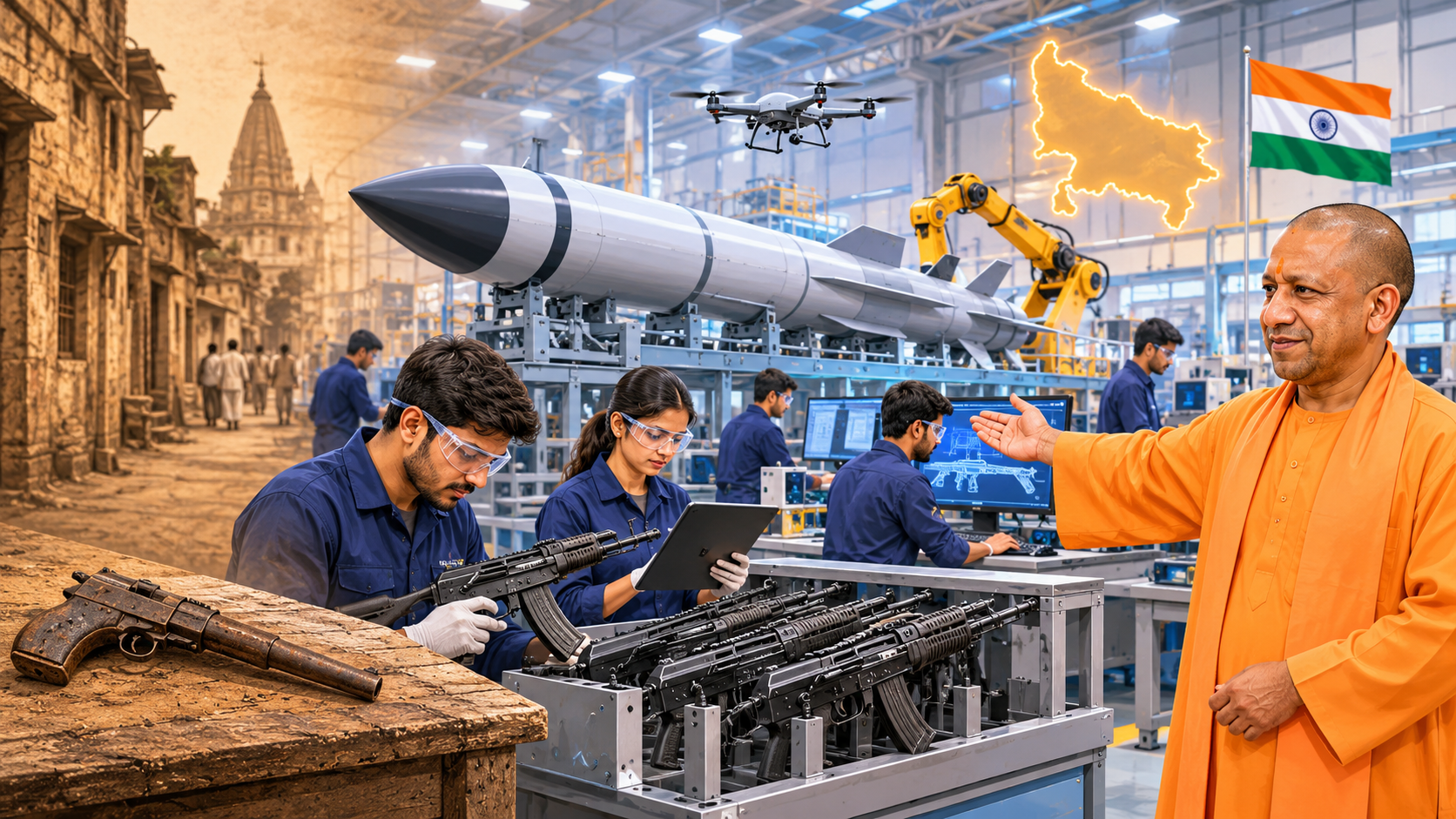
From katta to cruise missile
The Chief Minister did not mince words about the past. Earlier governments, he said, "made kattas and bombs here, so their thinking went only that far." For decades, the crude country-made pistol shaped how outsiders saw the state.
पिछली सरकारों की बुद्धि कट्टा और बम से आगे नहीं बढ़ पाई। हमने कट्टा-बम के अवैध ठिकानों को ध्वस्त किया... https://t.co/3gZTQfdTjF
— Yogi Adityanath (@myogiadityanath) · November 27, 2026 · View post on X
Lucknow now makes the BrahMos supersonic cruise missile. Amethi makes the AK-203 assault rifle. "Remember, the young people working on BrahMos and the AK-203 are UP's youth," he told the hall. He also said, first train them in the technology and then arrange their campus selection.
What is being built
The BrahMos Integration and Testing Facility opened in Lucknow's Sarojini Nagar in May 2025. It cost ₹300 crore and stands on 80 hectares given free by the state. It is designed to turn out 80 to 100 missiles a year. The first batch was flagged off in October 2025, about five months after the unit opened.
The rifles come from Korwa in Amethi. Indo-Russian Rifles Private Limited, a joint venture set up in 2019, holds a contract for over six lakh AK-203s. Production began in January 2023. The plant has since test-fired 'Sher', an AK-203 made entirely from Indian parts and materials.
Both units sit in the UP Defence Industrial Corridor. Its six nodes are Lucknow, Kanpur, Aligarh, Agra, Jhansi and Chitrakoot.
The classroom gap
Factories need trained hands, the Chief Minister admitted, that state has done under double engine. Before 2017, its technical universities offered no courses in drone technology, robotics, the Internet of Things, 3D printing or space technology.
He asked how a young person from UP could ever join a satellite mission. "He would be forced to go to South India," he said. "If we do not teach him, why do we blame him?"
So he called in the AKTU Vice-Chancellor and kept following up until the courses began. Every technical university then got the same direction. Through AKTU, he has said, 500 young people have been selected for BrahMos and related units.
The shift has reached ITIs too. Outdated trades are giving way to drones, AI, robotics and solar technology. With Tata Technologies, the state has approved Industry 4.0 courses at 149 government ITIs, covering everything from EV repair to industrial IoT.
Defense is one door, technology services are another. The Chief Minister recalled visiting HCL's Lucknow campus within six months of taking office in 2017. He asked how many people worked there. The answer was 100, the company even offered to bring in outsiders to fill the hall.
He went back recently for HCL's golden jubilee event. The campus now employs 18,000 people across three shifts, he said. About 60 percent are young women. Some told him their shift ends at 2 am. They then ride home to Barabanki, Sitapur, Hardoi, Unnao and Rae Bareli. "Who is going to stop us?" they asked.
For the Chief Minister, that line sums up the change. Safety brought investment, he argued. Investment brought jobs that once needed a train ticket to Bengaluru or Pune.
Beyond defence
He also pointed to Noida, which he said now makes 55 percent of India's mobile phones. Taken together, these are his case for UP as a hub of education, technology and new-age industry. The goal he set the recruits was a $1 trillion state economy.
How many AI and drone graduates find work inside the state? How many stay? Can the corridor's suppliers and startups absorb the talent the campuses now produce?
A missile line in Lucknow, a rifle plant in Amethi and a fast-growing tech campus are on the ground. For a young engineer in Gorakhpur or Jhansi, the choice is no longer between leaving and settling for less. The katta once defined UP in the national imagination. Its youth now want to be known for the BrahMos.